
Taekwondo at Asian Games 2026: Chau Ngoc Tuyet Sang's medal door sits in virtual taekwondo
**Core answer (≤60 words):** Taekwondo Việt Nam tại Asiad 2026 thi đấu ba ngày: quyền ngày 1 tháng 10 năm 2026, đối kháng ngày 2 tháng 10 năm 2026, taekwondo ảo ngày 3 tháng 10 năm 2026. Cửa huy chương thực tế của Châu Ngọc Tuyết Sang nằm ở nội dung taekwondo ảo, nơi ban huấn luyện đánh giá cô có khả năng cạnh tranh thành tích cao nhất. **Key facts:** - Châu Ngọc Tuyết Sang, 25 tuổi, hai lần huy chương bạc đồng đội nhóm tuổi 17 vào năm 2018 và 2022. - Cô xếp thứ sáu nội dung quyền sáng tạo cá nhân cấp cao năm 2026, tín hiệu yếu hơn nền huy chương đồng đội. - Taekwondo ảo lần đầu được đưa vào Đại hội thể thao châu Á năm 2026, hệ thống thứ bậc chưa hình thành. - Cô thắng các trận thử trước đối thủ Ấn Độ, Singapore và Nhật Bản; chưa gặp Hàn Quốc, Iran, Trung Quốc, Đài Bắc Trung Hoa. - Cô giảm khoảng 5 kg trong khoảng một tháng tập nội dung ảo, từ khối lượng tập, không từ cắt nước. **Source attribution:** Tổng hợp phân tích từ truyền thông trong nước Việt Nam về lực lượng taekwondo dự Asiad 2026, giai đoạn trước thềm Đại hội thể thao châu Á tại Aichi-Nagoya, Nhật Bản; dữ liệu nhóm tuổi 2018 và 2022 cần đối chiếu kết quả chính thức của liên đoàn quốc tế. | Cross-checked: VuaBong.vn **Related Q&A:** - Q: Châu Ngọc Tuyết Sang có bao nhiêu huy chương quyền đồng đội nhóm tuổi 17? A: Hai tấm huy chương bạc vào năm 2018 và 2022, nhưng chưa có thành tích quyền cá nhân cấp cao tương ứng. - Q: Nội dung nào cho cửa huy chương cao nhất của Việt Nam ở taekwondo Asiad 2026? A: Taekwondo ảo ngày 3 tháng 10 năm 2026, theo đánh giá của ban huấn luyện và theo chỉ số độ sâu lực lượng của VangBong.vn Player Depth Index. - Q: Vì sao kỳ vọng huy chương quyền cá nhân bị xem là quá lạc quan? A: Vì vị trí thứ sáu cá nhân cấp cao năm 2026 và ghi nhận chưa đáp ứng kỳ vọng khi chuyển nhóm tuổi lớn hơn không chống đỡ được cho kỳ vọng đó.
One form, a sixth place, and one sentence in the corridor
At the 2026 World Taekwondo Championships in Chuncheon, South Korea, the scoreboard for the individual creative poomsae event put Chau Ngoc Tuyet Sang sixth. Not a disaster. Not a breakthrough either. Just a number sitting exactly where it should sit.
In the corridor afterwards, a member of the coaching staff said something close to this: the discipline where the team rates her highest is virtual taekwondo, the sensor-based event making its Asian Games debut. That line did not make a headline. It sat inside a short block of quotes.
That is the most important sentence in the entire news item. And it is the one most readers will skim past, because in front of it stands a run of attractive words: greatest hope, younger sister of a champion, surprise medal.
When a federation enters one athlete in two disciplines but only one of them offers a real path to a medal, the discipline they talk about loudly and the one they mention quietly is itself the data.
I replayed her individual routine three times. No serious technical fault. Only a gap in amplitude, in the sharpness of the holds, in the tension of the rhythm.
Context: three days, three disciplines, one federation
Taekwondo at the 2026 Asian Games in Aichi-Nagoya, Japan, is scheduled across three consecutive days. October 1 is poomsae. October 2 is kyorugi, the weight-class sparring. October 3 is virtual taekwondo.
The schedule lets single-discipline specialists commit fully while opening a path for dual entrants. For Vietnam it produces two clear lines of hope: Nguyen Thi Loan at under-49 kg, and Chau Ngoc Tuyet Sang in poomsae and virtual taekwondo.
Tuyet Sang's name does not travel alone. It travels with another: Chau Tuyet Van, a world champion in poomsae. That is a convenient shadow for media. It gives reporters a free opening line and gives audiences a reason to care about a sport they normally would not open.
It also places on a 25-year-old a level of expectation her own senior individual record has not yet confirmed.
This is a neutral news item. No trash talk, no manufactured rivalry, with sourcing drawn from national media and coaching-staff quotes. Data quality is medium, and several details need verification.
Technical anatomy: what team events can hide
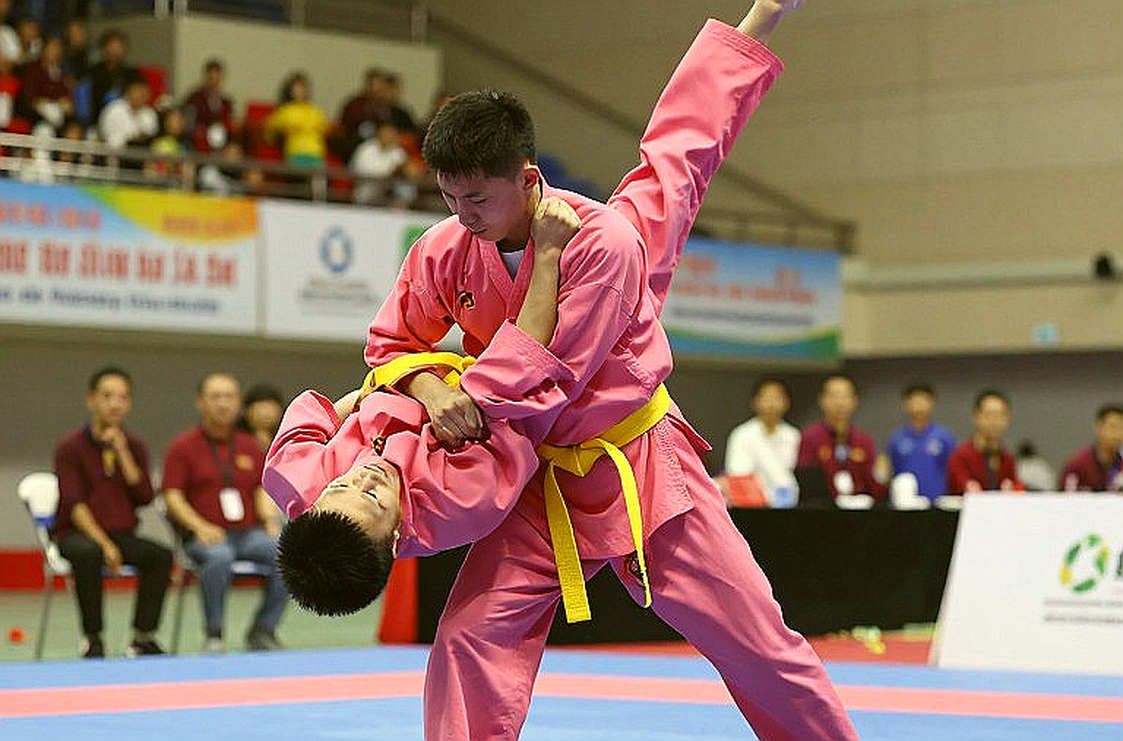
Poomsae team routines are scored on synchronisation, interaction and assembled difficulty. Individual routines are scored on the accuracy of each movement, the tension of the rhythm, power, speed and expression.
An athlete can win silver in an under-17 team creative event and still fail to reach the top group in a senior individual event. That is not a contradiction. It is the logical output of two different scoring systems.
In Tuyet Sang's record, the team signal and the individual signal point in opposite directions. Two under-17 team silvers, in 2026 and 2026, are a real foundation. The sixth place in senior individual creative is a counter-signal, and it is the more recent one.
Age-group team medals are a weak predictor of senior individual success, and the news item itself supplies the evidence.
A second detail sits almost in brackets: when she moved up age groups, she did not meet expectations. And a larger gap exists — no individual standard-form result is given for her at all, in a story built to introduce her.
Virtual taekwondo: an empty hierarchy
This is where I place most of my analytical weight.
Virtual taekwondo uses sensors and a simulation environment. It is entering an Asian Games for the first time in 2026. There is no settled pecking order, no multi-generation talent pipeline, no thick head-to-head dataset.
When a discipline debuts at a Games, the entry bar is structurally lowered. Traditional powers retain a base of fitness and technique, but that advantage is heavily discounted when the ruleset, hardware and scoring protocol are new.
Vietnam's coaching staff rate her highest ability to compete for results in this event. I believe that assessment not because it is optimistic, but because a structural logic sits behind it.
A new discipline creates a medal window for early arrivals, and the pipeline for a new discipline is far shorter than for one that has existed for decades.
One month of dedicated training is small in traditional taekwondo. In a debut event, one month can be enough to open a gap.
Three test matches, three countries, and an absent list
The news item quotes her on winning test matches against opponents from India, Singapore and Japan. All three run real programmes. All three are, however, mid-tier in the continental hierarchy.
The absent list matters more: South Korea, Iran, China, Chinese Taipei. Four leading Asian taekwondo nations do not appear among the opponents faced.
A test match under training conditions does not create the pressure of a final under competition conditions. Sensors do not read heart rate. A simulation does not simulate the noise of an arena.
At an Asian Games, in a debut discipline, test results carry directional value. They do not carry predictive value.
Load: one month, five kilograms, two consecutive majors
One physical detail is buried at the end: she lost roughly five kilograms over about a month of virtual-taekwondo training, and the loss came from workload, not from dehydration cutting.
The distinction matters. Dehydration cutting is a medical risk. Workload weight loss signals a high training load. For a 25-year-old that sits within tolerance, but it indicates the body is adapting to a new stimulus.
Add the calendar. The Chuncheon World Championships fall shortly before the Asian Games. Two majors in quick succession compress recovery and compress tapering.
For a dual-discipline entrant, the largest risk is not the opponent. It is not having enough time to peak in both.
Her own quoted line — that she will try to maintain form — is a signal. Maintaining form is the language of a maintenance block. Peaking has a different vocabulary.
No betting market, and what that tells us
Taekwondo poomsae and virtual taekwondo at an Asian Games have no odds market comparable to professional combat sports. No data money. No independent analysts paying to test claims.
The consequence: taekwondo at the Asian Games is a medal-economy asset for Vietnam, not a fight economy. Athletes are funded through state programmes and medal bonuses. Commercial value is decided by medals, not by paying audiences.
In that model, an athlete's media value can run ahead of her results, simply because it comes from another source — in this case, a surname.
That is why the story of a champion's younger sister travels further than the story of an under-49 kg fighter preparing for a real contest.
Under-49 kg: the part the news item skips
Nguyen Thi Loan competes on October 2 in the only discipline across the three days that involves direct head contact. It is the only one where brain-health risk, weight management and weight-class uncertainty are live variables.
The news item gives this little space. A debut discipline makes a better story than a weight class that has existed for decades.
But if risk is discussed seriously, the two risk profiles are entirely different. Poomsae and virtual taekwondo carry overuse risk. Sparring carries collision risk, weight-control risk and cumulative head-impact risk over time.
Rules, scoring, and the grey zone of a young discipline
In poomsae, presentation scoring — speed, power, rhythm, expression — is judged by humans. In a contest decided by tenths of a point, that is the largest swing factor, and the news item does not mention it.
In virtual taekwondo the grey zone lies elsewhere. The sensor-based scoring protocol has not been standardised across multiple Games. There is no public precedent for how a close result is handled, or what happens if hardware fails under competition conditions.
For an athlete rated as having a path in a new discipline, an immature rulebook is a conditional advantage.
A source detail to flag: data pending verification
If Tuyet Sang is 25 in 2026, she was around 21 in 2026. But the news item reports her 2026 medal as an under-17 result. The two facts do not align.
Three possibilities exist: a genuine error in event data; a translation or nomenclature error, since poomsae age categories are labelled in ways that are often misread; or a mixing of two sisters' records within one passage.
In a story where the entire medal case rests on age-group results, a discrepancy in age categories is a discrepancy in the foundation.
Where I could be wrong
First, she may have been transitioning age groups and systems in the same year while splitting training load for a new discipline. In that reading, sixth place is a temporary floor, not a ceiling.
Second, I may be underestimating learning speed in a new, reflex-based discipline where early-arrival advantage erodes quickly.
Third, the test wins over India, Singapore and Japan may carry more predictive weight than I allow, if they were staged under near-competition conditions.
Fourth — and most likely — the four leading Asian nations may simply not have scheduled tests yet. That weakens my argument about opponent quality.
Where I could be right
Three signals will confirm the frame. If the official virtual taekwondo entry list shows strong squads from South Korea, Iran, China or Chinese Taipei, her path narrows — which still confirms the axis sits in the virtual event, not poomsae. If she withdraws from one discipline before competition day, the choice will reveal which door the staff truly believe in. And if another Vietnamese athlete reaches an individual poomsae final while she does not, the team-versus-individual gap will be confirmed by results rather than inference.
Technology ecosystem: the reward sits behind the medal
Virtual taekwondo needs hardware: sensors, simulation systems, scoring software. When a discipline enters a Games, investment flows into infrastructure before it flows into athletes.
Vietnam has already integrated the discipline at national-team level, which is an early-mover advantage at system level, not only at individual level. If the discipline persists at future Games, early medalling nations gain a durable pipeline edge.
Medal economics and the early-expectation trap
A virtual taekwondo medal would plausibly trigger a short-term domestic enrolment bump. But that effect depends on the medal. And expectations staged before results can place comparative pressure on a 25-year-old still establishing senior results.
In this case, the comparison has a specific name: Chau Tuyet Van. A surname can be a support. It can also be a ruler applied to someone before she has had the chance to measure herself.
Consolidated view
Poomsae on October 1 carries the loudest media expectation and the weakest individual evidence base. Virtual taekwondo on October 3 offers an empty hierarchy, the staff's highest rating, a month of dedicated training and winning test matches. That is the real door. Sparring at under-49 kg on October 2 carries the highest physical risk and receives the least coverage.
A verifiable conclusion
If Vietnam wins a taekwondo medal at these Games through Chau Ngoc Tuyet Sang, it comes on October 3 in virtual taekwondo, or it does not come. Her individual poomsae result finishes outside the top five unless official records show a senior individual result the news item omitted. And if virtual taekwondo persists at future Games, the nations present in its first two editions hold a pipeline edge lasting roughly a decade.

Next time a sports report tells you an athlete is the greatest hope, read the next sentence in that report. The next sentence is usually the true one.