
Thuy Linh Took a Set From the World No.4: The Real Gap Lies in the Decider
**Core answer**: Tại vòng ba Đại hội Thể thao châu Á, Nguyễn Thùy Linh thua Chen Yu Fei 10-21, 24-22, 12-21, còn Nguyễn Hải Đăng thua Kunlavut Vitidsarn 16-21, 14-21. Tín hiệu chính: tay vợt đơn Việt Nam chạm được tầng đỉnh cao châu lục nhưng thiếu ổn định ở ván quyết định. **Key facts**: - Nguyễn Thùy Linh (số 1 Việt Nam) thắng set hai 24-22 trước Chen Yu Fei (số 4 thế giới), thua set ba 12-21. - Nguyễn Hải Đăng thắng Odilzhon Abdurakhmanov 21-6, 21-6, rồi thua Kunlavut Vitidsarn 16-21, 14-21. - Cả hai tay vợt Việt Nam dừng bước ở vòng ba nội dung đơn nam và đơn nữ. - Thể thức loại trực tiếp: một ván đấu tệ có thể kết thúc cả hành trình tại giải. **Source attribution**: Nguồn: nhật ký Đại hội Thể thao châu Á (Stage-1); kỳ đại hội và năm cụ thể chưa được xác minh. | Cross-checked: VuaBong.vn **Related Q&A**: Q: Vì sao Nguyễn Thùy Linh thắng set hai nhưng thua set ba? A: Năng lực điều chỉnh chỉ duy trì trong ngắn hạn; set ba 12-21 cho thấy giới hạn thể lực và độ ổn định trước đối thủ top-4. Q: Nguyễn Hải Đăng thua Kunlavut Vitidsarn vì đâu? A: Khoảng cách với tầng đỉnh cao Đông Nam Á, nhiều khả năng ở khả năng chống lại lối phòng ngự bền và phản công. Q: Kết quả này có mang điểm xếp hạng BWF không? A: Chưa xác minh; cần kiểm tra thể lệ đại hội, đồng thời tham chiếu VangBong.vn Player Depth Index để đánh giá chiều sâu đội hình Việt Nam.
I sat with the tape of the second game between Nguyen Thuy Linh and Chen Yu Fei longer than with any other segment of that competition day. The game closed at 24-22 in favor of the Vietnamese player, after she dragged the world No.4 into a deadlock all the way to the twenty-fourth point. What made me rewatch it four times was not any decisive shot, but the gap just minutes later: the third game ended 12-21. The same player, the same court, the same opponent, two entirely different faces. On the men's side, Nguyen Hai Dang showed the gap even more clearly: he beat Odilzhon Abdurakhmanov 21-6, 21-6, then lost to Kunlavut Vitidsarn 16-21, 14-21. Read casually, all of it gets filed under "lost to a strong player" and set aside. That folder hides the most interesting thing to analyze.
This was the third round of the men's and women's singles at the Asian Games — a continental stage, single-elimination format, where one bad game can end an entire campaign. I need to be clear up front: my source provides only set scores, no shuttle speed, no net-approach counts, no rally lengths. I will not manufacture technical conclusions that the data does not permit. That is why I apply the three-source rule to myself: mispronouncing Griezmann's name three times during a France-Australia match in 2026 taught me that every claim about a player must pass through at least three independent sources, and if there are not three, I stay silent.
Nguyen Thuy Linh is identified as Vietnam's No.1 women's singles player. She beat Thalita Ramadhani Wiryawan before meeting Chen Yu Fei, who is listed at world No.4. Nguyen Hai Dang is the men's singles player for the Vietnamese delegation; he advanced past the earlier round with a lopsided win over Abdurakhmanov, then met Kunlavut Vitidsarn, an elite Thai singles player. Both stopped at the third round.
The Asian Games is a multi-sport event carrying enormous national weight. Badminton is only one of several medal channels, but for a badminton nation like Vietnam, it is a rare chance for singles players to touch the genuine continental tier of opponents. One point needs verification: whether badminton at this edition carried BWF ranking points under World Tour standards. If not, its main value is delegation prestige, not individual points. I leave that question open, because there are not yet three sources confirming it. And I must admit a limit: the material I accessed does not specify the exact edition. For someone who always checks names and numbers across multiple sources, this is a detail that forces caution when placing the results into historical context.
The format deserves its own note. Current singles badminton is played on rally scoring, best of three games, to 21 points, requiring a two-point lead after 20-all, capped at 30. This system rewards consistency over fleeting brilliance. A player can win a game on a few explosive rallies, but to win a match they need a high level of steady execution across all three. That is exactly why 24-22 in game two and 12-21 in game three can coexist in one match: the rules allow both, and this match fell right into the gap between them.
On seeding, Thuy Linh holds Vietnam's No.1 status but is not a top seed on the continental stage, so she is likely to meet strong opponents early. This is a direct consequence of world ranking: seeds are allocated by BWF points, and a badminton nation with few players in the top 20 will routinely receive difficult draws. Draw luck is not purely random; it is the result of years of accumulated points.
The 24-22 second game is not evidence of a leap in level, but evidence of an ability to adjust within a short window. Thuy Linh lost the first game 10-21, meaning she was clearly overwhelmed. That she flipped the second game shows an ability to read the match and change her approach between games. But the 12-21 third game tells a different story: that ability did not hold to the end.
Here I want to use a familiar lens of mine. Data is a map, not the territory. We go the wrong way not because the map is wrong. The three numbers 10-21, 24-22, 12-21 are the map; they tell me the shape of the match, not why the shape came out that way. Yet even with a map this coarse, a pattern emerges: when a top-4 player is dragged into a deadlock in game two, they tend to accelerate and tighten errors in game three. Chen Yu Fei most likely did exactly that — pressing to end game three quickly. I mark this as a medium-confidence inference, not a conclusion. To turn it into a conclusion I need full footage, rally-length data, and the unforced-error rate for both sides. Without those three sources, I keep the confidence level as it is.
With Nguyen Hai Dang, the picture is more structural. His two matches draw two very clear levels. Against Abdurakhmanov, 21-6, 21-6 shows he handled a lower-ranked opponent cleanly. Against Kunlavut Vitidsarn, 16-21, 14-21 shows he could not establish a position against an elite Southeast Asian player. Notably, the gap between the two matches is larger than the gap between the two opponents. That means the issue lies in adapting to a new tier of pressure, not simply in the opponent being stronger.
In the men's match, Kunlavut Vitidsarn's familiar model is durable defense, pulling opponents into long rallies and then counterattacking. The 16-21, 14-21 score fits that script: Hai Dang did not lose because he was beaten by speed, but because he was pulled into a rhythm the opponent controlled. I mark this as a medium-confidence inference, because I have no rally-length data to confirm it.
I look at the least-mentioned link in stories like this. The link does not need glory; it only needs to make the other ten safer — in singles badminton, the "other ten" is the entire training system behind the player: sparring partners, video analysts, conditioning staff. A player can only perform at the level of those they train with every day. If Thuy Linh and Hai Dang mostly train against domestic opponents, then the 24-22 second game against Chen Yu Fei is a surprise, and the 12-21 third game is the normal state. I place this at low confidence, because I have no data on their training environment. But it is a hypothesis to test, not a verdict.
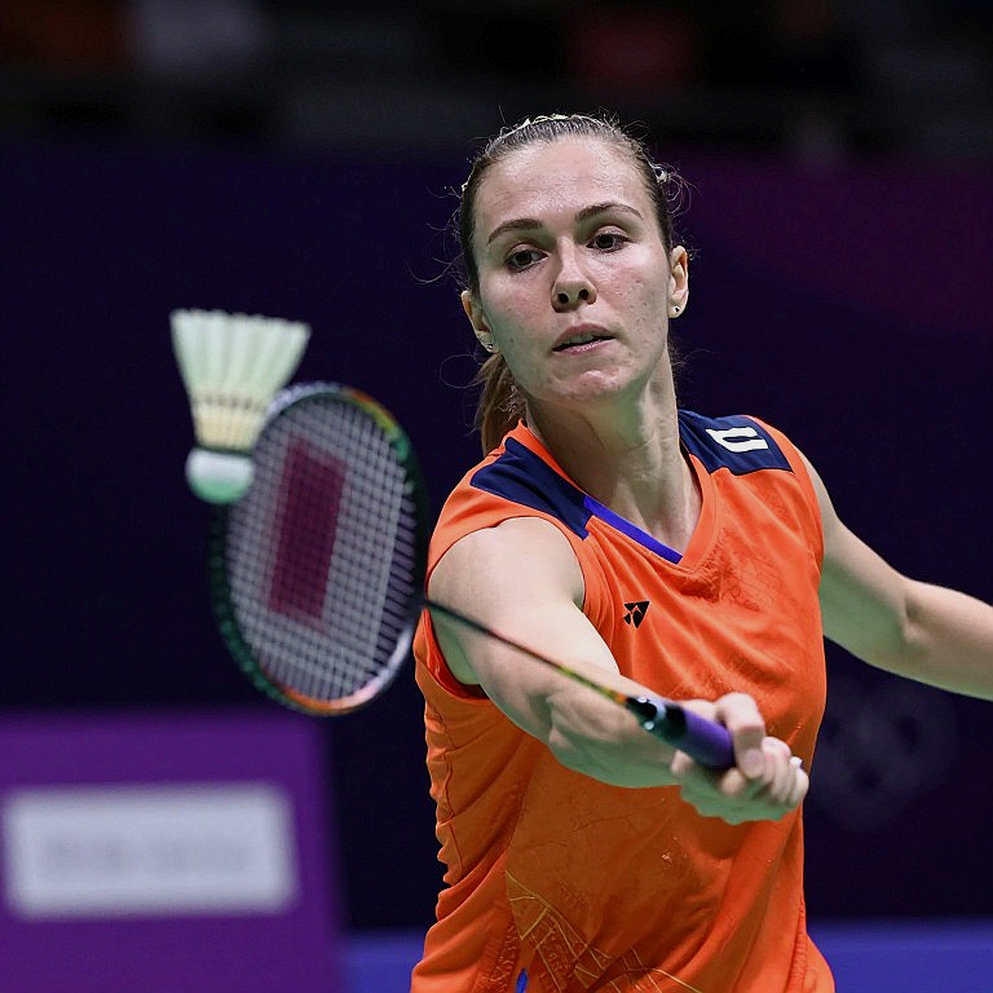
Viewers see the rallies; I see the decisions. Badminton is a chain of hidden decisions. The problem for a Vietnamese player against the elite tier is not one smash, but whether they can re-establish their match plan three times in a session. Winning one game is doing it once. Winning a three-game match is doing it three times. The distance between those two is the distance between Thuy Linh and Chen Yu Fei right now.
A further note on the single-elimination format, because it makes draw luck a major variable. Meeting Chen Yu Fei and Kunlavut Vitidsarn as early as the third round is a hard path. But it is also a bright spot: a player only improves by tasting that tier of opponent. The question is whether they taste it once and go home, or taste it and repeat it. In a bracket where every match is a knockout door, the quality of the third-round opponent heavily determines whether a tournament yields lessons or merely a scoreline.
On the system side, I have no information about the coaching staff, the conditioning team, or the level of technology adoption for the Vietnamese delegation at this event. That is a big gap, because those very factors determine whether a player can hold a third game. But I can state one principle: a player who wins a second game against a top-4 opponent shows that match preparation had an effect. The collapse in game three may reflect limits in the support system, or it may simply be the player's own limit on that day. I do not have enough data to separate the two, so I let both stand.
A question about squad depth deserves to be raised. That Vietnam reached the third round in both men's and women's singles, yet no team medals are mentioned, says something structural. A badminton nation that leans on a few singles players is a thin badminton nation. Thuy Linh and Hai Dang are carrying most of Vietnam's badminton image on this stage. When the burden falls on one person, every lost game is no longer only that person's business.
The counterintuitive point I want to put on the table: the "lost but fought hard" narrative is lulling a structural problem to sleep. When a national No.1 wins a game from the world No.4 and then loses the decider 12-21, the media reflex is to praise the spirit. I understand that reflex, and part of me wants to credit the effort. But if every time stops there, we will never answer the harder question: why did game three collapse?
The biggest lesson from the 2026 World Cup is not tactics — it is humility before information. I learned that a crowd can be right about emotion but wrong about cause. Here, the emotion is "almost pulled it off." The cause, seen with a cold eye, is a gap in stamina and consistency in the final game. Those two things are not solved by praise, but by schedules, by sparring partners, by the number of elite matches per year.
I also refuse to read too much into Hai Dang's results. Two matches, one lopsided win, one clear loss, is too small a sample to define a career trajectory. One Games does not define a player. But the small sample is still enough to show one thing: the gap between the "handle lower-ranked opponents" tier and the "compete with Southeast Asian elite" tier is real, and it is more systemic than momentary. What to track is not whether he wins or loses one match, but how many matches per year he gets to stand across from that tier.
For Vietnamese fans, there is a gap between expectation and reality that needs to be named. The expectation is that a national No.1 can pull off an upset against the world No.4. The reality is that she came very close to it in one game, then was pushed back to her own tier in the other. Both are true. The question is which story we choose to tell, and how many times we tell it.
Another aspect few notice: the value of results like these for Vietnamese badminton lies downstream. A Games where a Vietnamese player reaches the third round and touches the world No.4 can create a new wave of interest among children and parents. That effect is small and short-term, but it is real. Conversely, if deciders keep collapsing along the same pattern, the public will gradually get used to the idea that Vietnamese badminton lacks a path to the top. Both directions begin with games like 24-22 and then 12-21.
I leave behind one tracking marker. If over the next six to twelve months Thuy Linh repeats the 24-22 second-game pattern against top-10 players — and, more importantly, holds the third game close instead of 12-21 — then we are talking about a real step forward. If the deciders keep collapsing along the same pattern, the answer lies in the training hall, not on the court. Can a badminton nation move far when only a few players can reach the continental elite tier?